
The Month I Put Money Behind My Best Affiliate Offer: Paid Traffic Scaling Story About How to Scale Affiliate Marketing With Paid Traffic
This article follows one month of paid traffic as a worked example. The numbers are made up and chosen to be easy to calculate, so swap in your own as you read. They are there to show how the decisions connect, not to predict what your results will look like. Costs per click, conversion rates and commissions vary widely between niches, offers and platforms, and your own figures are the only ones that matter once real money is involved.
The order of the stages is the useful part: choose the offer, set a spending limit, run a small test, read the results, then raise spend in steps. Each stage answers a question that the next one depends on, so skipping ahead is how budgets get burned.
The test only means something if you set the limit first, and a spend increase only makes sense if the test results hold up. Along the way, each spending decision ties back to the $25,000 monthly target and the high-ticket math already published on this site, so you end up with a framework you can reuse for any offer rather than a tour of ad platforms.
The example affiliate has a site with steady organic traffic, a few converting offers, and a $25,000 monthly goal. They are curious about ads and wary of wasting money. If that describes you, the path below is built for you.
Why organic success is the best head start for paid traffic
Paid traffic costs money for every click, whether or not the visitor buys. The biggest risk is paying to learn things you could have learned for free: which offer appeals to your audience, which angle gets people to click, and which page turns readers into buyers.
Organic traffic answers those questions at no per-click cost. If a review post has brought in sales for months, you already know that people searching for that topic want that offer and that your page persuades them. Paid traffic then buys more visitors to a page that already works. Someone starting from zero has to find all of that out with ad money.
Your organic data is also your planning baseline. It tells you roughly what share of visitors click through to the offer and what share of those buy. You need both numbers for the break-even math later.
One caution: ad visitors usually arrive colder than someone who found your page by searching a specific question. Treat your organic conversion rate as an upper limit when planning, and expect the paid rate to be lower.
Choose the one offer worth paying to promote
Pick one offer. Splitting a small budget across several offers gives you thin data on all of them and a clear answer on none.
The right offer meets four conditions:
- It already converts for you. Look for real sales or at least a steady stream of clicks to the offer from organic pages, not a program you like the look of.
- The commission leaves room to pay for traffic. A $5 commission can’t absorb a $2 click. A high ticket commission can, which is part of why high ticket offers and paid traffic pair well. If you are still comparing programs, how to choose high ticket affiliate programs covers what to check first.
- The terms are clear. Read the program’s rules on paid advertising before spending anything. Some programs restrict which traffic sources or keywords you can use, and some do not allow certain ad types at all. Check refund and reversal windows too, since a sale that is reversed was not really income.
- You can describe the buyer in a sentence. Targeting needs a concrete audience, such as people searching for a specific comparison or people dealing with a specific problem.
In the example, the affiliate has a comparison post about one high-ticket program. It brings in a modest but regular number of sales each month. That post and that offer become the test.
Work out your break-even cost per sale before you spend anything
Do this before you open an ad account. The math is short, and it sets the limit on everything else.
Step one: your commission per sale. Suppose the offer pays $500.
Step two: your break-even cost per sale. If you spend $500 in ads to earn one $500 commission, you break even, ignoring your own time and tool costs. That is the absolute ceiling. Spending more than that on average loses money.
Step three: your target cost per sale. Aiming for break-even leaves no margin for error, so set a lower target. In the example, it is $250, half the commission. That figure is a choice, not a rule. A cautious beginner might pick a lower share of the commission, and someone who values list growth might accept a higher one.

Step four: your maximum cost per click. Divide your target cost per sale by the number of clicks you expect to need for one sale, or multiply it by your click-to-sale rate. Suppose that on your organic page, 0.5% of visitors who reach the offer end up buying. A $250 target cost per sale divided by 200 clicks per sale gives $1.25 per click.
That $1.25 is your decision number. If the platform quotes you $0.60 a click for your audience, there is room to work. If it quotes $4, the math fails at your current conversion rate, and you need to improve the page or choose a different audience before spending.
Two adjustments keep this honest:
- Lower your assumed conversion rate for paid visitors, since they tend to be colder than organic ones.
- Leave email list value out of the first calculation. A subscriber who buys later is a bonus, not part of the break-even case.
Run a small test budget and decide what you are really measuring
The test budget should be an amount you can lose without it affecting anything else. In the example, it is $300, spent over about ten days at a low daily cap, on one platform and one audience.
At that size, the test usually cannot prove whether the offer is profitable. At a $1 click and a 0.5% conversion rate, $300 buys about 300 clicks, which is about one and a half expected sales. One sale or none can both happen by chance, so a result of zero sales does not mean the offer failed.
For that reason, measure the things that show up in volume:
- Cost per click. Is it at or below your maximum?
- Click-through rate on the ad. Are people interested in the message?
- Landing page to offer click rate. Of the people who arrive, how many continue to the offer?
- Email opt-in rate. Of the people who arrive, how many join your list?
- Time on page and basic behavior. Are visitors reading or leaving at once?
Sales are the final measure, but these upstream numbers tell you whether the sales are likely to come. If clicks are cheap, the page sends a healthy share of visitors to the offer, and your organic page converts them at a rate close to your baseline, the first sales are only a matter of volume.
Write down your decision rules before you start, while you are calm. For example: “If the cost per click is more than double my maximum after 100 clicks, I pause. If the offer click rate is under half of my organic rate after 150 clicks, I change the page. If the numbers are within range, I let the test finish.” Rules written in advance stop you from making choices based on one bad day.
Also keep your ad copy and disclosures in order. Promotional content has to follow advertising and endorsement rules, and the FTC guidelines for affiliate marketers are a good place to check yours.
Send ad clicks to a page that earns them, and capture emails
Where the click lands matters as much as the ad. Sending paid visitors straight to an affiliate link usually gives you less control and less data, and some platforms and programs restrict it. A page on your own site lets you set expectations, answer objections, and track what visitors do.
For the test, the example affiliate uses the existing comparison post as a starting point and makes a few changes for ad visitors:
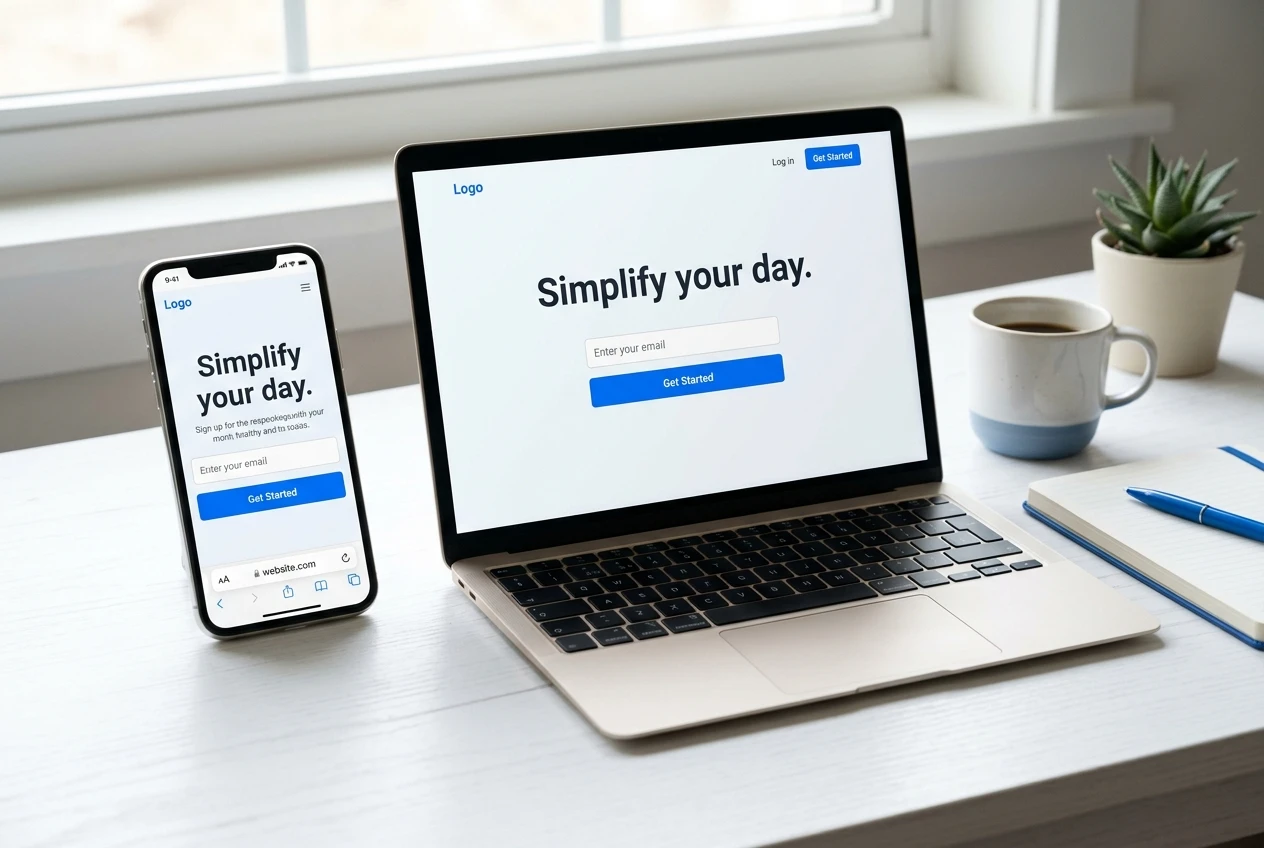
- Match the ad promise. If the ad says “compare these two programs,” the headline should say the same thing, so visitors know they are in the right place.
- Put the answer near the top. Cold visitors will not read three screens of background before reaching the recommendation.
- Use one clear next step. A single prominent link to the offer works better than six competing choices.
- Explain what the offer costs and who it suits. Honest information filters out people who will not buy, which saves you money on clicks that were never going to convert.
- Offer an email option. Many visitors need more than one visit before buying, especially for a higher-priced offer. A short lead magnet or useful email series lets you continue the conversation after the click has been paid for.
Email changes the economics of paid traffic. A visitor who leaves without buying is a lost click. A visitor who joins your list is a contact you can follow up with at no extra cost per message. For help setting this up, see this beginner’s guide to building an email list.
Keep the email promise specific and the sign-up form short. An opt-in page that asks for a name, a phone number, and three survey answers will collect fewer addresses than one that asks for an email alone.
Read the early data: when to cut, fix or keep going
After the test, you will have a set of numbers and three possible decisions. Each one points to a different problem.
Cut: the cost per click is too high for the math
If clicks cost far more than your maximum and the audience is already narrow, there is no page change that rescues the numbers. Stop, record what you learned, and go back to the organic side. Maybe a different offer, a different audience, or a different platform fits better. A test that stops at $300 instead of $3,000 did its job.
Fix: clicks arrive, but the page does not hold them
If the cost per click is acceptable but few visitors continue to the offer or join your list, the ad is working, and the page is not. Common causes are a headline that does not match the ad, an unclear recommendation, a slow-loading page, or a layout that is hard to read on a phone. Change one thing at a time so you know which change helped. This is the cheapest kind of problem to solve, since the traffic is already paid for.
Keep going: the numbers are inside your limits
If the cost per click is below your maximum, the page sends a reasonable share of visitors to the offer, and some are joining your list, extend the test with the same settings. You still do not have enough sales to prove profitability, but you have a good reason to collect more data. Plan a second budget of similar size and apply the same rules.
Resist reading too much into a single sale. One sale in the first week can come from luck, and so can none. A sensible target for the second round is several clicks large enough that your expected sales are more than a handful, and then compare your actual cost per sale to your $250 target.
Raise spend in steps without breaking what works
Once the numbers hold over a meaningful number of clicks, raise the budget in small steps. Large jumps are risky for two reasons. Ad platforms often change delivery and costs when a budget changes sharply, and a bigger audience may respond differently from the first group you reached.

A cautious pattern for the example:
- Hold the budget steady until the cost per sale falls within your target for a full round of data.
- Raise the daily budget by roughly 20 to 30 percent, and then wait several days before judging the result.
- Check the same numbers each time: cost per click, offer click rate, opt-in rate, and cost per sale.
- If a number moves outside your limit, step back to the previous budget and look for the cause before trying again.
- Change only one thing at a time. Raise the budget or test a new ad, not both in the same week.
The 20 to 30 percent figure is a working guideline, not a rule from any platform. Smaller steps are slower and safer, and larger steps are faster and riskier. Choose the pace you can tolerate if a step goes wrong.
Set a monthly ceiling too. Decide the most you are willing to spend in total this month and treat it as a hard cap, so a run of good days cannot lead you to spend more than you planned. Also keep track of the numbers that show whether you are actually profitable: commissions earned, minus ad spend, minus any reversed sales. Revenue alone can look healthy while the account loses money.
When a second platform or a second offer looks tempting, wait. Scale the first offer until its cost per sale starts to rise, which usually happens as you exhaust the best-matching audience. A rising cost per sale is the signal to add something new.
Where paid traffic fits in a $25,000 month
Return to the target. Suppose the offer pays $500 per sale. A $25,000 month from that offer alone needs 50 sales. The exact break-even and commission math for high ticket offers is laid out in the math behind a $25,000 high ticket affiliate month, and your own numbers may look quite different from the example.
Now see what paid traffic could contribute. Suppose organic traffic produces 30 of those sales. The remaining 20 would need to come from somewhere else: more content, more email, more offers, or paid traffic. At the $250 target cost per sale, 20 paid sales cost $5,000 in ads and earn $10,000 in commissions, leaving $5,000 before other costs. If your actual cost per sale is closer to $400, the same 20 sales cost $8,000 and leave $2,000. If it climbs past $500, the ads lose money, and the math tells you to stop.
This is why the spending decisions in this article all trace back to the goal:
- The commission sets how much you can afford to pay per sale.
- The target cost per sale sets your maximum cost per click.
- The monthly sales gap sets how much paid traffic you actually need, so you do not buy more than the goal requires.
- The ad budget ceiling keeps one bad month from erasing the profit from several good ones.
Paid traffic is also not the only way to close a sales gap. If organic content, email follow-up, and a better landing page can cover it at lower cost, they may be better first moves. Paid traffic earns its place when you have a proven offer, a page that converts, and a cost per sale that fits inside your limit. At that point it is a way to buy more of a result you already know how to produce.
Take the break-even math from the high-ticket article at /math-behind-a-25-000-high-ticket-affiliate/ and work out your own cost per sale limit before you place your first ad.